Platform
Sessions, tariffs, payments, permits, violations, appeals, settlement, the control console and the reporting a council actually reads — on one instance, with one data model and one audit trail.
PEMS — the Parking Enterprise Management System™ — is where the estate becomes a programme. Every sensor, camera, pay station, sign and handheld reports into one instance, and every motorist channel, officer workflow, permit, appeal and settlement runs from it. One system, one data model, one audit trail.
Modules
Live per-bay state, session start and end, duration, turnover and the raw session record that every other module reads from.
Rates, time limits, bay classes, grace periods, free periods and zone rules — all configuration, versioned, with an effective date and an approval record.
Kerbside station, mobile, web, QR and UPI channels reconciled against the detected vehicle, with automatic plate-to-payment matching.
Application capture, issuance, renewal and revocation for resident, trader, staff, accessible and visitor permits, validated at the bay against the plate.
Detection, evidence packaging, a quality-assurance gate before issuance, and the completed record handed to the authority's own recovery process.
A citizen-facing challenge route with the evidence attached, a decision workflow, and a record that stands behind a contested notice.
Daily settlement, revenue-share reconciliation, exception handling and the monthly pack an authority's finance team actually needs.
One console for the estate: device health, zone status, sign content, live occupancy and the operational picture the control room works from.
Compliance by zone, violation types, recovery performance, appeal outcomes, complaint themes — the inputs to a quarterly policy review rather than a monthly slide.
This is the commitment that everything else rests on. When a city changes a tariff, adds a bay class, alters a grace rule, introduces a maximum stay on one frontage, changes a language on a notice or re-zones a district, that is a configuration change made by the operator — not a change request that joins a supplier's roadmap.
We can make that commitment because we hold the right to change the product. The sensing, the recognition models, the kerbside hardware and the platform software are engineered here, under licence, with the right to modify. There is no third party whose priorities have to be persuaded, and no commercial reason for a supplier to decline.
A city should never be told that a policy it has decided on is a twelve-month software project.
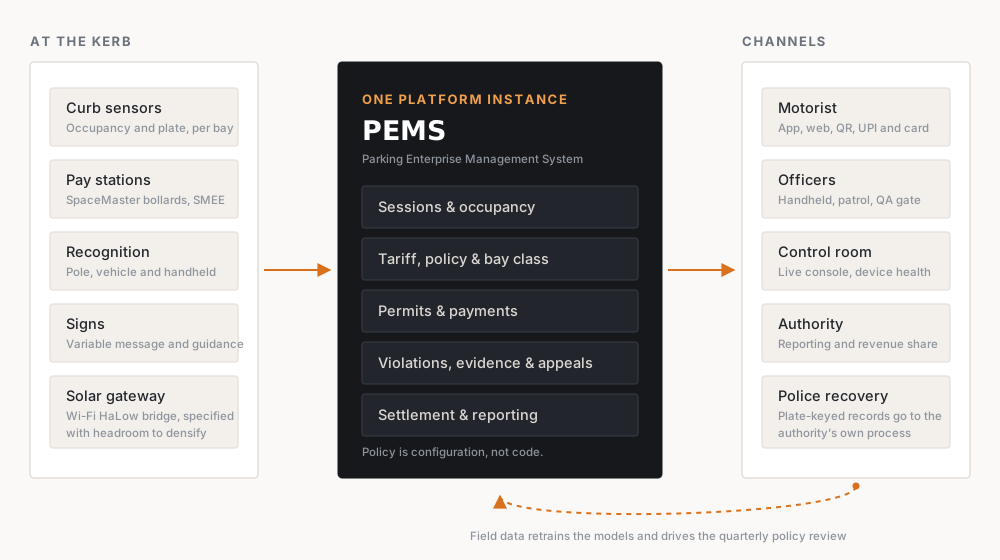
A new zone attaches rather than integrates: a gateway, the devices, and the zone is on the estate — because the addressing, the security model and the data model are already defined for it. Gateways are specified with headroom, so a zone can densify without a network change. Structured facilities, park-and-ride sites, charging bays and off-street parcels all join the same instance instead of accumulating separate systems the finance team then has to reconcile by hand.
The same discipline runs through the hardware. Equipment is designed to be replaced by its successor without replacing the street around it — the habit of mind behind the replaceable meter mechanism that let cities re-use housings as the technology inside them changed, and the reason a kerbside estate should be a thirty-year asset rather than a seven-year one.

Privacy, security and data
Completed violation records are transmitted to municipal and police systems keyed to the vehicle plate. No owner name, civil identity number, address or contact detail needs to be held in, or pass through, an operator system.
Deployments are configured for local data-residency and protection requirements, including hosting on infrastructure the authority controls where the contract or the regulation requires it.
A range of privacy options on image capture and retention, so a city can meet its own rules on what is recorded, for how long, and who may see it.
Every session, payment, detection, decision and configuration change carries an audit record built to be read by an auditor and to stand behind a contested notice.
Motorist-facing and staff-facing modules run in the local language and English as equals — not as a translation layer bolted on at the end — and extend to further languages.
The bay register, the digital twin, the session history and the inventory are the authority's property from the day they are produced, and leave with the authority at the end of the term.
A payment channel that a city's drivers do not already use is a channel that will not be used. We support the full set and expect a city to tell us which ones matter on its streets: kerbside pay station, mobile application, mobile web, QR scan-to-pay, UPI and local wallet rails, contactless card, chip and swipe, and coin where it is still required. Session extension, receipts, permit application and challan or citation payment all run through the same account.
Guidance closes the loop: live availability by vehicle class in the app and on the approach signs, so the driver's decision is made before they enter the block rather than after three laps of it.
We would rather walk you through the console against a real zone than a demo dataset. Tell us which city and which streets.